Can You Sing in Tune? The Pitch Accuracy Test
Rate My Singing is a free online singing test in two parts: the eight-second take above, which scores range, steadiness and tone from 1 to 10, and the pitch accuracy test on this page. A pitch accuracy test plays reference notes and measures how closely you sing them back, reporting the error in cents instead of a pass/fail grade. The take above scores how your voice behaves. This second test answers the other question people mean by "rate my singing": am I hitting the right notes?
Pick the range that suits your voice, listen to the five notes, then sing them back. Every note is measured against its target and reported in cents, the standard unit for pitch error, where one semitone is 100 cents.
Five notes play first, then you sing them back on an open vowel such as "ah". Headphones help but are not required.
Nothing is uploaded. Your recording never leaves this browser tab.
The reference notes finish playing before recording starts, deliberately. If they were still sounding while you sang, the microphone would pick up both pitches at once and the detector would have no way to tell which one was yours.
Reading Your Pitch Accuracy Result
A cent is one hundredth of a semitone, and the scale of what matters is narrower than most people assume.
Look past the individual notes to whether your errors all lean the same way. That is the single most useful thing in the result. Consistently sharp or consistently flat across all five notes is a different problem from scattered errors, and the test calls it out separately when it sees one.
A systematic lean is usually mechanical and quite fixable: singing flat throughout often comes from insufficient breath support, and singing sharp from pushing too hard. Scattered errors that jump either side of the target point at ear training more than technique: you are not hearing the target clearly before you produce it.
Two things the test deliberately forgives
Octaves. Singing the pattern an octave above or below the reference is musically correct, so it scores identically. Only pitch class is compared. Without this, every lower voice following the higher reference would be marked wrong on all five notes, which would say more about the measurement than about the singer.
Slides into the note. Only the middle half of each note is measured. Sliding up to pitch and tapering off at the end are normal singing behaviours and no sign of poor intonation, so the head and tail of every note are excluded before anything is calculated.
How the Singing Test Differs From the Speaking Test
It is the same acoustic engine underneath, with three deliberate changes so that it judges singing fairly.
The take is eight seconds instead of five, because a sung phrase needs room to move through several notes before its range means anything. Pitch range jumps from 6% to 20% of the score, and the ceiling for a full range mark rises from ten semitones to sixteen, a whole octave and a third. And the expressiveness target moves from about three semitones of pitch movement to about five and a half, since pitch variation that would read as instability in speech is simply melody in singing.
The practical consequence is that the two tests are not comparable. A voice that scores 8.2 speaking might score 7.4 singing without anything being wrong. The singing bar is set higher on purpose.
The Seven Marks and How They Are Weighted
The 1-10 total is built from seven separate measurements, each scored on its own and then combined with fixed weights. Knowing the weights tells you where the marks are, the way knowing an exam's mark scheme does.
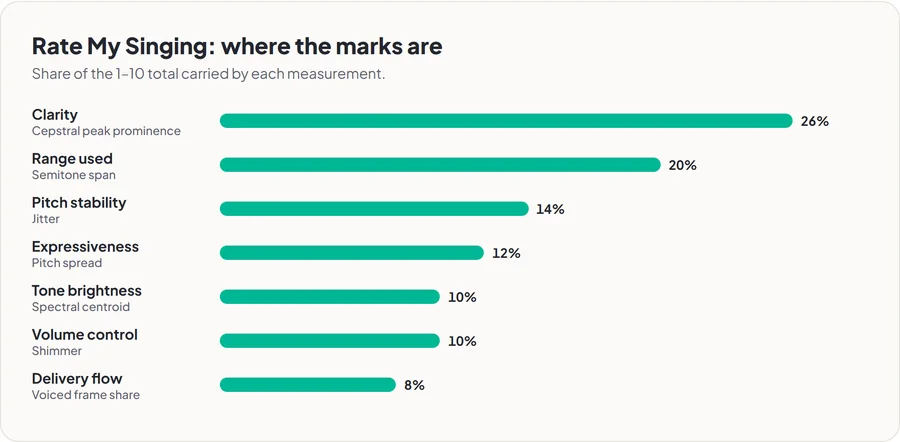
The largest single mark, at 26%, is clarity: how close your spectrum sits to a clean harmonic comb, measured as smoothed cepstral peak prominence, or CPPS. Second, at 20%, is range used, how much pitch territory you covered in the take, with the full mark needing sixteen semitones, an octave and a third. Pitch stability (cycle-to-cycle jitter, the fine grain of how steadily your vocal folds vibrate) carries 14%. Stability sits lower than you might expect on a singing test, because published jitter thresholds are defined on a sustained vowel, while a sung phrase moves pitch by design.
The remaining four: expressiveness (pitch movement, with a target around five and a half semitones of spread) at 12%, volume control (evenness of loudness, from shimmer) and tone brightness at 10% each, and delivery flow (the share of the take that carried a fully voiced tone, with breathy or broken stretches left out) at 8%. The practical upshot of this weighting: a sustained single note scores well on stability but forfeits most of the range mark, so the instruction says to move between notes. Alongside the total you also get your range as note names and a voice type leaning, soprano through bass, inferred from average pitch. Treat that leaning as a starting point and leave the real classification to a vocal coach.
Your Vocal Range and What It Means
After each take you get your range expressed three ways: in semitones, in hertz, and as note names such as E3 to D#4. The semitone figure is the one worth tracking, because it is the only one that compares fairly across different voices: twelve semitones is one octave whether you are a bass or a soprano.
Some rough reference points for the range used in a single comfortable phrase, leaving aside your full stretched range: an untrained singer typically covers eight to twelve semitones, a comfortable trained performance covers twelve to eighteen, and anything beyond two octaves in one continuous take is genuinely unusual.
To map your full range, beyond what one phrase shows, record twice. First slide slowly down to the lowest note you can hold cleanly without dropping into vocal fry, and read the low note name from the result. Then slide up to your highest sustainable note without straining, and read the high note. Sliding matters, because the pitch detector needs continuous voiced sound to track you, and jumping between notes leaves gaps it cannot follow.
A word of caution on the low end: vocal fry, that creaky rattle at the very bottom, is not a usable singing note and the analyser will often reject it as insufficiently periodic. That rejection is the analyser working as intended.
Pitch Steadiness, Vibrato and What the Numbers Show
Pitch stability on the singing test comes from the same cycle-to-cycle jitter measurement used for speech, and it is one of the more revealing numbers for a singer. It captures the fine grain of how steadily your vocal folds are vibrating, at a scale far below the note-to-note level you can hear yourself. It carries less weight than it used to, because the published jitter thresholds are defined on a sustained vowel, while a sung phrase moves pitch on purpose and some of that intended movement gets counted as perturbation.
Two things commonly drag it down. The first is inconsistent breath support: as the air runs out at the end of a phrase, both jitter and shimmer rise sharply, so the last two seconds of an eight-second take often carry the worst numbers. Pick a phrase you can comfortably finish without running out of breath, and the result will be noticeably better. The improvement reflects real technique.
The second is a cold or tired voice. Both raise jitter measurably, which is one reason singers who track these numbers weekly can often see a bad vocal day in the data before they consciously feel it.
On vibrato: a controlled vibrato is a regular oscillation of roughly five to seven cycles per second, and because it is periodic and deliberate it does not inflate the cycle-to-cycle jitter figure much. It does widen your measured pitch spread, which feeds expressiveness. An uncontrolled wobble, by contrast, shows up in both. If your expressiveness reads high while stability reads low, that combination is worth paying attention to.
Getting a Take That Represents You
Four things reliably produce a more representative result:
That third point is the one people get wrong most often. Any audible backing track, even quietly through speakers, puts competing periodic pitch into the microphone, and the pitch detector has no way to know which fundamental frequency belongs to you. Sing unaccompanied, or use closed-back headphones so no sound leaks back.
What the Singing Test Measures
The eight-second take cannot tell you whether you sang in tune. It has no idea what song you chose or what notes you intended, so it measures how steadily you held a pitch but never whether it was the right pitch. A confident performance of entirely wrong notes will still score well on stability. The pitch accuracy test above fills that gap, and it supplies the notes itself because intonation can only be measured against a known target.
Even so, the pitch test has a boundary of its own. It tells you whether you hit five sustained notes, which is not the same as whether you sing a whole song in tune. Real intonation drifts with breath, register changes and the difficulty of the interval you are jumping. A good score is evidence that your ear and your voice agree on a simple target. Whether a whole performance will hold together is a separate question.
It also cannot judge tone, phrasing, emotional delivery, diction, or whether your voice suits a genre. Those are the things a vocal coach is for. What it does give you is an objective, repeatable set of acoustic numbers that respond to warm-ups, technique and vocal health, which makes it useful for tracking your own progress over weeks. Compare against your own earlier takes only, never against anyone else's screenshot.
If you want the same engine applied to your speaking voice, with all seven sub-scores broken out individually, use the speaking voice rater.
Frequently Asked Questions
Last reviewed: 6 September 2026
How does the singing rater score me?
The singing mode uses the same acoustic engine as the speaking test but re-weights it for singing: pitch range rises from 6% to 20% of the score, clarity stays the largest single mark at 26%, pitch stability eases to 14%, and the expressiveness target moves from around three semitones to around five and a half, because singing legitimately covers much more pitch movement than speech.
Does it check whether I am singing in tune?
Yes, in the pitch accuracy test at the top of this page. It plays five reference notes, you sing them back, and it reports how far each note landed from the target in cents (a semitone is 100 cents). What it cannot do is judge a song you choose yourself, because then it has no reference to compare you against. The separate eight-second take covers steadiness and range instead, with no intonation check.
What counts as a good pitch accuracy score?
Inside 15 cents on average is excellent and effectively inaudible, since most listeners cannot hear an error that small. Up to 30 cents still reads as in tune to almost everyone. Beyond 50 cents, half a semitone, the error is clearly audible as being off. If your average sits around 20 to 30 cents you are singing in tune by any normal standard, whatever a strict number might suggest.
Does it matter if I sing the notes in a different octave?
No. Singing the pattern an octave above or below the reference is musically correct, so the test compares pitch class only and gives an octave transposition the same score. This matters most for lower voices following the higher reference range, which would otherwise be marked wrong on every single note.
How do I find my full vocal range?
One eight-second take only shows the range you used in that take. To map your full range, record separately for your lowest comfortable note and your highest, sliding gradually with no jumps, and read the note names from each result. Trained singers typically cover two octaves or more, while an untrained comfortable range is often around one and a half.
What does the voice type leaning mean?
It is a rough bucket (soprano, mezzo, contralto, tenor, baritone or bass leaning) inferred from your average pitch. Real voice classification depends on tessitura, timbre and register transitions that a short recording cannot capture, so treat it as a starting point and leave the verdict to a vocal coach.
Why did my singing score come out lower than my speaking score?
Singing is measured against a harder standard. Range is weighted more than three times as heavily, and the expressiveness target assumes real melodic movement. Holding a single sustained note for eight seconds will score well on stability but poorly on range, which pulls the total down.
Should I warm up before the test?
Yes, if you want the result to represent you. Pitch steadiness is measured from cycle-to-cycle jitter, and jitter on a cold voice is measurably worse. It is weighted lightly here, at 14%, because jitter thresholds are defined on a sustained vowel and a sung phrase moves pitch by design, but five minutes of gentle humming and lip trills still changes the numbers, not just the feeling.
Is my singing uploaded anywhere?
No. All analysis happens locally in your browser. Nothing is sent to a server, stored or recorded anywhere outside your own tab.