How Background Noise Changes a Voice Test Result
Noise makes any voice sound rougher to a measuring tool. We added controlled noise to three real recordings and watched what happened to clarity, score and estimated age.
A fan, a laptop, traffic outside or a busy room all add noise to a recording. To a human listener the voice still sounds the same. To voice analysis, noise looks almost exactly like a breathy or rough voice, because both add energy between the harmonics.
That matters for any voice test, and especially for age estimates. Older voices tend to be rougher, so an uncorrected tool can mistake a noisy room for an older speaker. Our first version did exactly that, so we now measure the recording's noise level and correct for it. This guide shows how well that works and where it falls short.
The test
We used the first 8 seconds of three public-domain LibriVox readings: two healthy adult voices (Readers A and B) and one rough, low-quality recording (Reader C). Each clip was analysed clean, then again with steadily stronger background noise added, down to a signal-to-noise ratio of about 10 dB. That is roughly a voice recorded in a noisy cafe on a phone held at arm's length.
The noise was generated with a fixed random seed, so the results repeat exactly. The signal-to-noise figures on the chart are the ones the site itself measured from each recording, using the quiet gaps between words.
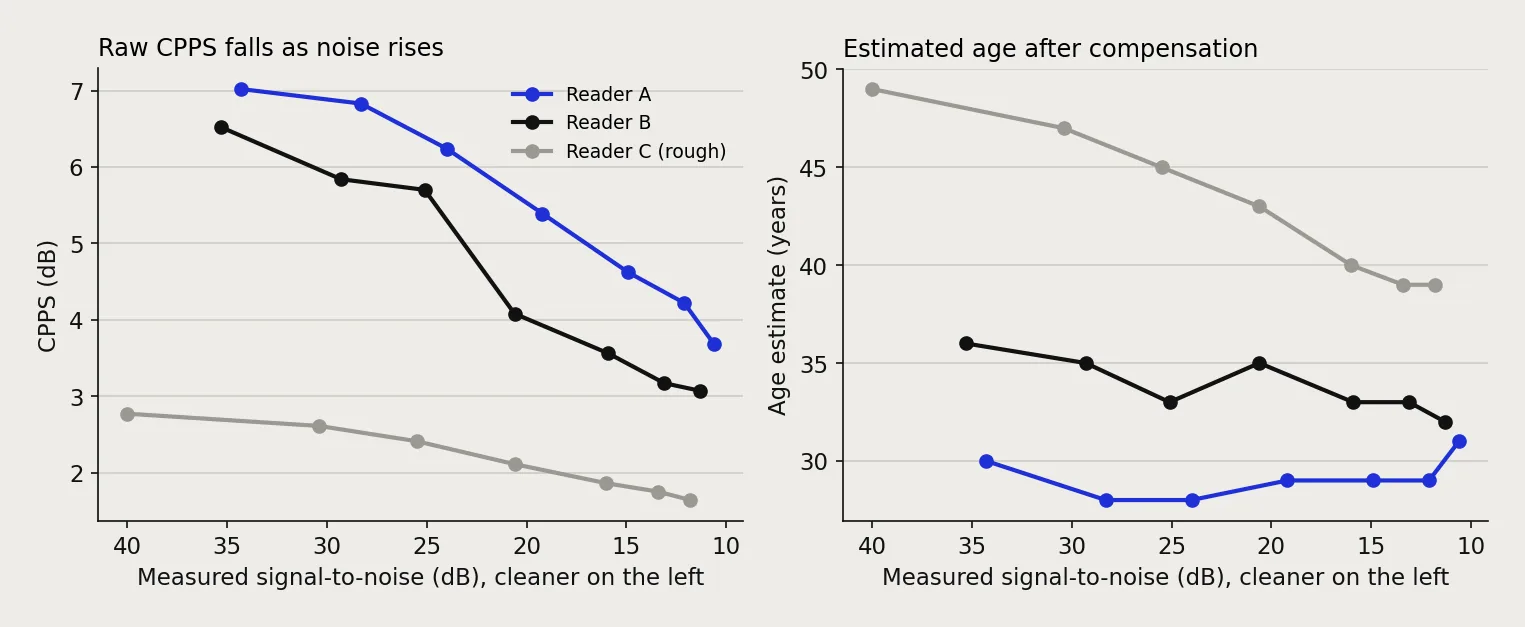
Finding 1: raw clarity drops sharply
The left chart shows the cepstral peak prominence, the main clarity measure, before any correction. For Reader A it fell from 7.02 dB in the clean clip to 3.68 dB in the noisiest one. Reader B fell from 6.52 dB to 3.07 dB. In other words, adding noise to a healthy voice pushed its raw clarity down to the level of the rough recording, which measured 2.77 dB clean.
This is why an uncorrected voice test is unreliable in a normal room. The voice did not change at all. Only the recording did.
Finding 2: the corrected score and age hold steady for healthy voices
The site estimates how clean each recording is from the level of the gaps between words, and gives back part of the clarity that noise takes away. With that correction in place, the healthy readers' results barely moved.
| Reader | Score, clean to noisiest | Age, clean to noisiest | Age range across all levels |
|---|---|---|---|
| Reader A | 8.0 to 7.7 | 30 to 31 | 28 to 31 |
| Reader B | 7.9 to 8.1 | 36 to 32 | 32 to 36 |
| Reader C (rough) | 6.6 to 7.1 | 49 to 39 | 39 to 49 |
For comparison, the version of the site before this correction made a clean test recording read about seven years older once noise was added. For the two healthy readers the drift is now three or four years at most, and it does not run in one direction.
Finding 3: the correction can flatter a voice that is already rough
Reader C behaves differently, and it is worth being honest about it. As noise was added, the age estimate fell from 49 to 39 and the score rose from 6.6 to 7.1. The correction gives clarity back based on how noisy the recording looks. For a voice that is genuinely rough, part of that roughness gets treated as noise and credited back.
So the correction protects healthy voices from being judged older in a noisy room, but it can make a strained voice in a noisy room look younger and clearer than it is. The cleaner your recording, the less correction is applied and the more the result reflects your actual voice.
How to record for a reliable result
- Find the quietest room available. Turn off fans and close windows. Soft furnishings help more than a bare room with echo.
- Hold the microphone about a hand's width from your mouth. Closer raises your voice above the room noise. Too close and plosive sounds distort.
- Leave a short pause before you start speaking. The site measures the noise floor from quiet moments, so a second of silence helps it judge the room.
- Check the recording quality line. If a result page shows a recording quality warning or a low signal-to-noise figure, record again somewhere quieter before trusting the age or score.
For comparing results over time, the room matters as much as the text you read. Record in the same place each time, and combine this with the three-take method from why your voice score changes every time you test.
Limits of this test
The added noise is broadband and steady, like a fan or air conditioning. Real rooms also have speech in the background, music and echo, which affect pitch tracking in other ways not tested here. Three readers is a small sample, and only one of them is a rough voice, so the over-correction seen with Reader C should be read as a warning sign, not a precise measurement.
Find out how old your voice sounds, recorded properly. Quiet room, a second of silence, then speak.
Take the voice age test