Why Your Voice Score Changes Every Time You Test
Record twice and you will rarely get the same number. We measured how much a score moves within a single reading, and found that most of the change comes from what you say, not from the tool.
The most common complaint about online voice raters is that the score jumps around. One take says 7.4, the next says 8.1, and it is fair to ask whether the number means anything. Some tools really do return a figure that has little to do with the audio. When I read the public page code of the top-ranking voice raters in August 2026, one sent the recording off to a server, one never asked for microphone access at all, and one measured nothing beyond pitch.
A tool that genuinely measures your voice will still move between takes, because your voice moves between takes. The useful question is how much movement is normal, and what you can do to keep it small. So we tested it.
The test: one reading, seven takes
We took three 20-second public-domain audiobook readings from LibriVox. Reader A and Reader B are healthy adult voices recorded cleanly. Reader C is a rough voice on a lower-quality recording, included to see whether the spread changes when the voice itself is strained.
Each reading was cut into seven overlapping 5-second windows, starting every 2.5 seconds. Five seconds is the length the home page asks for, so each window stands in for one ordinary take. Every window was scored with the same analysis code the site runs in your browser. Nothing about the speaker, the microphone or the room changed between windows. Only the words did.
What the numbers show
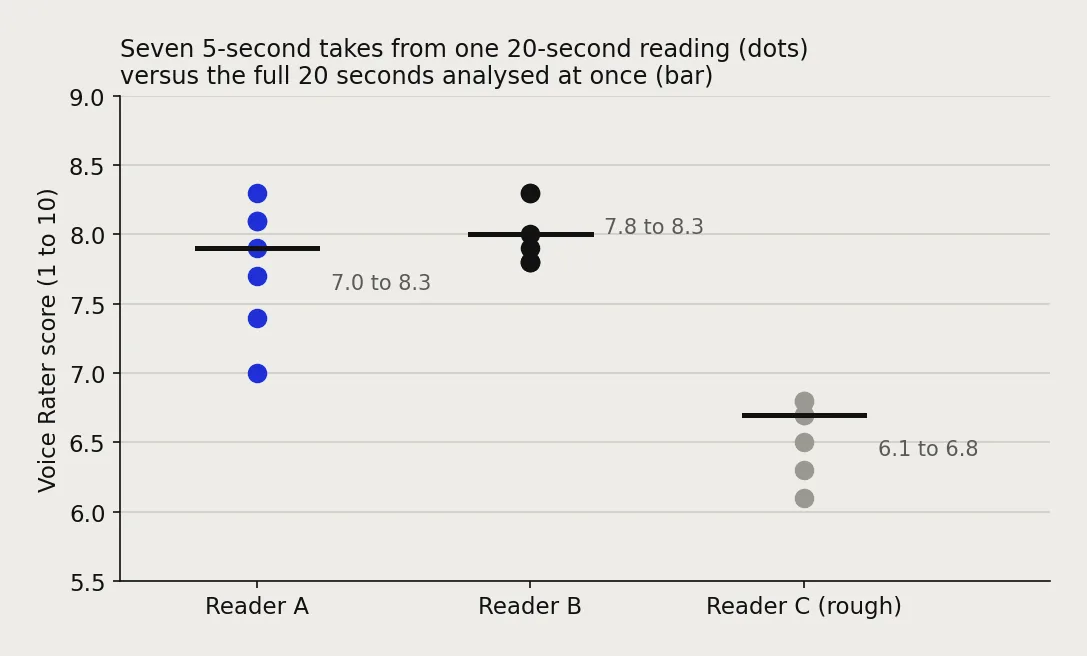
| Reader | Seven 5-second takes | Spread | Full 20 seconds |
|---|---|---|---|
| Reader A | 7.0 to 8.3 | 1.3 points | 7.9 |
| Reader B | 7.8 to 8.3 | 0.5 points | 8.0 |
| Reader C (rough) | 6.1 to 6.8 | 0.7 points | 6.7 |
Within one continuous recording, a single take moved by as much as 1.3 points. That is the gap between "solid" and "very strong" on our scale, produced by nothing more than which five seconds were picked. Reader B, who reads in a calmer, more even style, moved by less than half as much.
Two things held steady, and they matter more than the exact score. First, the ranking never flipped: Reader C's best take (6.8) stayed below the worst take of either healthy reader (7.0). Second, the full 20-second result landed close to the middle of each reader's takes. Longer audio does not change your voice, it just averages out the parts that are not about your voice.
Why a few seconds change the result
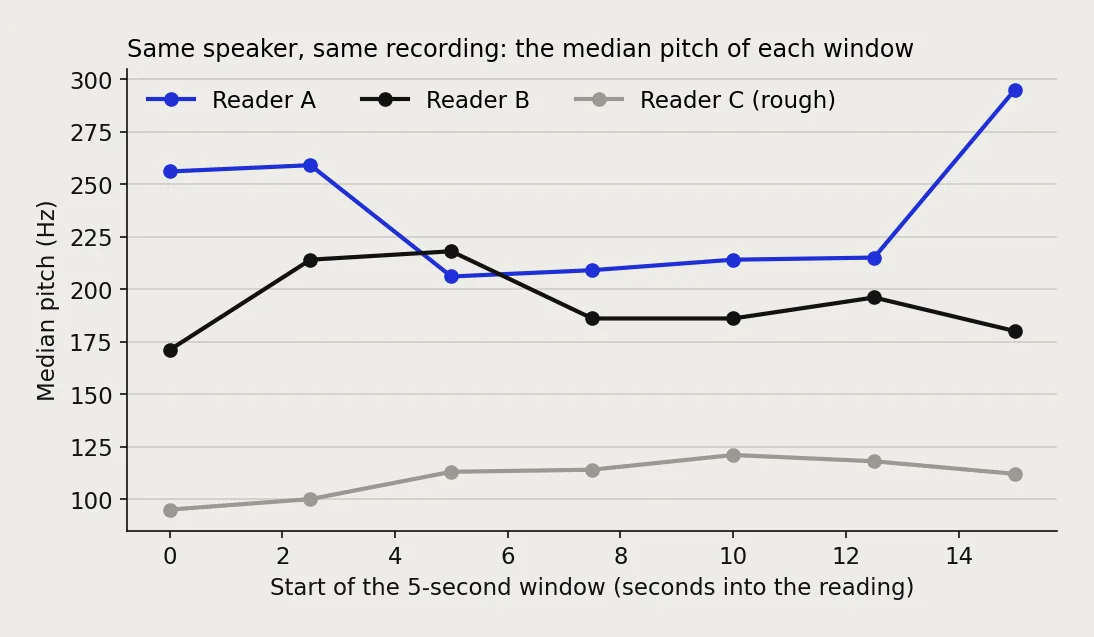
Reader A shows the main cause clearly. The median pitch of each window ranged from 206 Hz to 295 Hz, even though it is one person reading one passage in one sitting. A question, an emphasised word or a quoted line pulls the pitch up or down for a few seconds. The pitch-related parts of the score follow it.
Voice quality measures move too. The cepstral peak prominence (CPPS), the main clarity measure, ranged from 6.08 dB to 7.07 dB across Reader A's windows. Cycle-to-cycle pitch variation, called jitter, ranged from 2.60% to 5.67%. A breathy phrase, a trailing-off line ending or a fast run of consonants all register as changes in these numbers, because to the maths they are changes in the sound.
The age estimate is steadier than the score. Across the seven takes it stayed between 29 and 36 for Reader A and between 33 and 37 for Reader B. The feminine-masculine reading also held: Reader A sat between 79% and 85% feminine in every window. Pitch alone moved far more than that, because the gender read-out also uses resonance, which depends on the size of the vocal tract and does not change from sentence to sentence.
How to get a reading you can compare
If you want to track your voice over time, or compare yourself before and after practice, the goal is to keep everything constant except your voice. Four habits do most of the work.
- Read the same text every time. A fixed sentence or short paragraph removes the biggest source of change measured above. Free conversation is the noisiest possible input.
- Record longer than five seconds when you can. In this test the full 20 seconds landed near the centre of the spread each time. Ten to fifteen seconds is a sensible middle ground.
- Take three readings and keep the middle one. The median of three ignores one unusually good or bad take, which is exactly the kind of outlier seen with Reader A.
- Keep the room, microphone and distance the same. Background noise has its own effect on the raw measurements, covered in how background noise changes a voice test result.
Treat any difference smaller than about half a point as noise rather than progress. A change of a full point that repeats across three takes on the same text is much more likely to be real.
What this test does not show
Three readers is a small sample, and all of them were reading aloud rather than speaking freely. Spontaneous speech usually varies more than reading, so expect a wider spread in casual use. The windows also overlap, which means neighbouring takes share some audio and the true take-to-take spread may be a little larger than measured here.
The test also cannot tell you which take is the "real" score. They are all real measurements of different stretches of sound. That is why the advice above focuses on making takes comparable, rather than on finding a single correct number.
Try the three-take method on your own voice. Same sentence, three recordings, keep the middle score.
Rate my speaking voice