Male vs Female Voice Frequency: Real Hz Ranges, Measured
The textbook ranges are about 90 to 155 Hz for adult men and 165 to 255 Hz for adult women. We measured 40 real readers to see how well those ranges hold, and where men and women actually overlap.
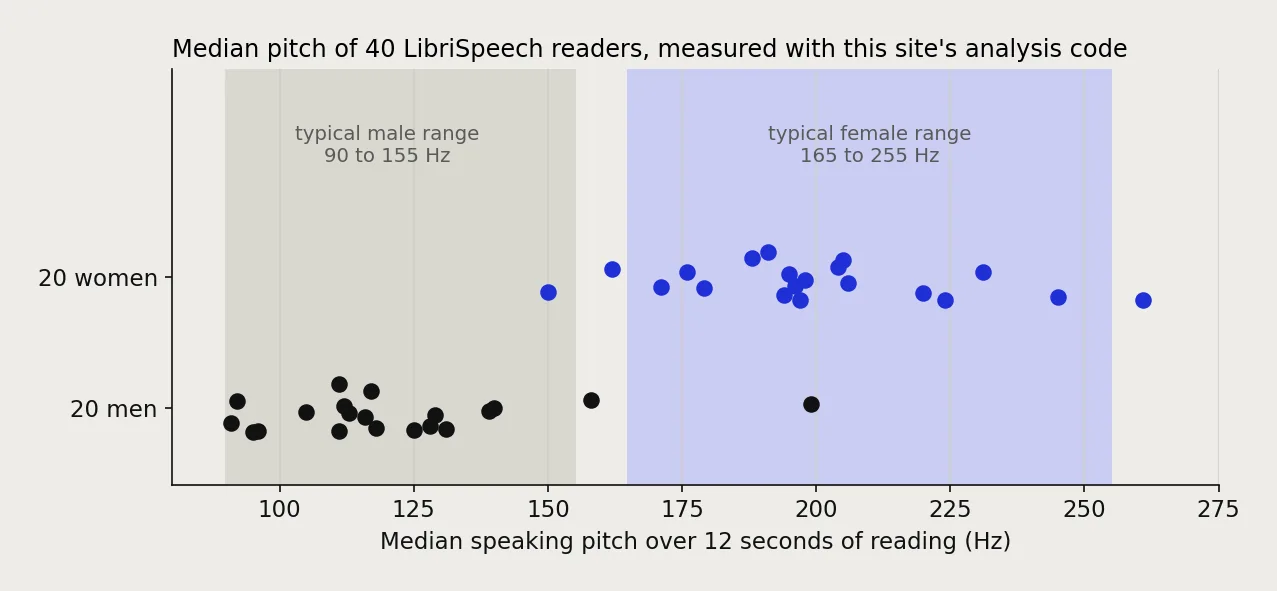
What Hz is a typical female and male voice? Adult men usually speak at about 90 to 155 Hz and adult women at about 165 to 255 Hz, the ranges given on Wikipedia's voice frequency page. In our 40 measured readers the middle woman spoke at 196.5 Hz and the middle man at 116.5 Hz. The middle half of the women sat between roughly 186 and 210 Hz, the middle half of the men between roughly 110 and 130 Hz, and the two groups met in a narrow zone around 155 to 175 Hz.
Test your own voice frequencyThe frequency people mean when they ask how high or low a voice is, is the fundamental frequency: how many times per second the vocal folds open and close while you speak. Longer, heavier vocal folds vibrate more slowly, which is the main reason adult men tend to speak lower than adult women. The commonly quoted ranges, given in the Wikipedia article on voice frequency, are 90 to 155 Hz for a typical adult man and 165 to 255 Hz for a typical adult woman. Some sources start the male range at 85 Hz.
Those ranges are a fair summary, but they hide two things that matter when you look at your own number. The edges are soft, and the two groups do overlap. So we measured.
Voice frequency, fundamental frequency and the frequency curve
"Voice frequency" has two common meanings. In telephony it is the band of roughly 300 to 3,400 Hz that a phone line carries, which is why calls can sound thin. In voice science it usually means the fundamental frequency, the pitch you hear, which is the 90 to 255 Hz territory this guide is about. The rest of a voice's sound is made of harmonics at whole multiples of that pitch, shaped into formants by the throat and mouth. Our tools report the fundamental; the formants are covered in pitch vs resonance.
The test
We took 12 seconds of read speech from each of the 40 speakers in the LibriSpeech dev-clean set, 20 women and 20 men. LibriSpeech is a public corpus of audiobook recordings released under a CC BY 4.0 licence, with each speaker's sex in its metadata. Every recording was analysed with the same code that runs on the Voice Hz Test, which reports the median pitch: the middle value of every voiced moment in the take, so a few odd frames cannot drag it.
What we found
| Group | Median of the group | Lowest reader | Highest reader |
|---|---|---|---|
| 20 women | 196.5 Hz | 150 Hz | 261 Hz |
| 20 men | 116.5 Hz | 91 Hz | 199 Hz |
The textbook ranges held up well for most people. 17 of the 20 women fell inside 165 to 255 Hz, and 1 more sat just above it at 261 Hz. 18 of the 20 men fell inside 90 to 155 Hz. The typical woman in this sample spoke about 80 Hz higher than the typical man, a ratio of about 1.7 to 1, or roughly 9 semitones (an octave would be 12).
The exceptions are the useful part. Two women read below 165 Hz, at 150 and 162 Hz. Two men read above 155 Hz, at 158 and 199 Hz, and the higher of those two was well inside the typical female range. We checked that reading separately in Praat, which put him at 197 Hz, so it is not a measurement glitch. The zone between 155 and 175 Hz contained three readers: 158 Hz (a man), 162 Hz (a woman), 171 Hz (a woman).
How well does pitch alone separate the two groups?
Our gender detector's pitch cue crosses from masculine-leaning to feminine-leaning at 158 Hz, a value set before this test rather than fitted to these readers. Used as a simple cutoff, it put 19 of the 20 women and 18 of the 20 men on the expected side, 37 of 40. The misses were the woman at 150 Hz, the man at exactly 158 Hz and the man at 199 Hz. That is good for a single number, and it still leaves a few voices in every 40 where pitch alone points the other way. Read 158 Hz as a reference point, not a line you have to cross.
Why the overlap matters
A single pitch number cannot tell you how a voice will be heard when it lands in that middle zone, and our man at 199 Hz shows it can mislead outside it too. Listeners also use resonance, intonation and voice quality. In our pitch vs resonance test, we raised the pitch of all 20 men to between 189 and 209 Hz without touching resonance. The pitch-based reading scored every one of them 73 to 80% feminine, yet a speech model still heard 17 of the 20 as male.
How wide is one person's pitch range?
A speaking pitch is a centre point, not a single note. Within one 12-second reading, the gap between each reader's lowest stable pitch (5th percentile) and highest pitch (95th percentile) had a median of 136 Hz for the women and 94.5 Hz for the men, and 24 of the 40 readers moved across more than 100 Hz. The typical woman's low and high points sat around 145 and 280.5 Hz, the typical man's around 91 and 187 Hz. That is ordinary intonation, the rise and fall of questions and emphasis, not an unsteady voice.
Median, average, lowest and highest
Our Hz test reports several numbers, and they answer different questions:
- Median pitch is the one to compare with the ranges above. It is stable against a few squeaks or creaky frames.
- Average pitch sits above the median when you lift your voice on a few words, as people do on questions and emphasis.
- Lowest stable and highest pitch are the 5th and 95th percentiles of the take, the figures used in the range section above.
How to read your own number
Record a normal sentence at your everyday speaking volume, not a careful performance. Then look at the median. If it is clearly inside one of the typical ranges, that is where your speaking pitch sits. If it falls between 155 and 175 Hz, you are in the overlap, where resonance decides more of the impression than pitch does. Either way, this is an acoustic measurement, not an assessment of anyone's gender or voice health.
Expect your number to move a little between takes. Across the 40 readers, different 5-second stretches of the same reading had median pitches 16 Hz apart in a typical case. The guide on tracking voice training progress covers how to tell real change from that natural movement.
Quick questions
What Hz is a feminine voice? In our sample the middle half of the women spoke between roughly 186 and 210 Hz, and 17 of 20 fell within 165 to 255 Hz. Pitch is one cue among several, and a voice does not need to land in any range to be your own.
What is a typical Hz for a male voice? The middle half of our men spoke between roughly 110 and 130 Hz, with the group median at 116.5 Hz.
Is 165 Hz male or female? It sits in the overlap. Of the three readers we found between 155 and 175 Hz, two were women and one was a man, so resonance and intonation decide more than pitch there.
Can a man's voice be 200 Hz? Yes. One of our 20 men read at 199 Hz, and Praat measured him independently at 197 Hz.
Method and data
The 40 readers are every speaker in LibriSpeech dev-clean (openslr.org/12, Panayotov et al. 2015, CC BY 4.0). For each, we joined that speaker's first recordings into a 12-second mono clip at 16 kHz and ran it through the same voice.js file the site serves, in Node.js. The table lists every reading so you can check the figures above.
All 40 readings (median, 5th and 95th percentile pitch, Hz)
| Speaker | Sex | Median | 5th pct | 95th pct |
|---|---|---|---|---|
| 6319 | F | 150 | 116 | 299 |
| 3576 | F | 162 | 140 | 225 |
| 2277 | F | 171 | 140 | 232 |
| 8842 | F | 176 | 147 | 223 |
| 1988 | F | 179 | 133 | 255 |
| 1919 | F | 188 | 115 | 271 |
| 1462 | F | 191 | 143 | 263 |
| 1993 | F | 194 | 170 | 234 |
| 5338 | F | 195 | 155 | 301 |
| 84 | F | 196 | 168 | 259 |
| 5895 | F | 197 | 160 | 287 |
| 7850 | F | 198 | 136 | 308 |
| 6345 | F | 204 | 172 | 275 |
| 2412 | F | 205 | 96 | 302 |
| 3853 | F | 206 | 151 | 264 |
| 3081 | F | 220 | 62 | 286 |
| 1673 | F | 224 | 160 | 319 |
| 3536 | F | 231 | 187 | 345 |
| 2035 | F | 245 | 107 | 357 |
| 6313 | F | 261 | 164 | 309 |
| 6295 | M | 91 | 76 | 120 |
| 652 | M | 92 | 70 | 167 |
| 3000 | M | 95 | 75 | 191 |
| 2803 | M | 96 | 83 | 122 |
| 5536 | M | 105 | 86 | 137 |
| 3752 | M | 111 | 76 | 188 |
| 777 | M | 111 | 86 | 145 |
| 2428 | M | 112 | 92 | 162 |
| 8297 | M | 113 | 97 | 146 |
| 1272 | M | 116 | 90 | 198 |
| 5694 | M | 117 | 98 | 190 |
| 6241 | M | 118 | 100 | 238 |
| 2086 | M | 125 | 106 | 160 |
| 174 | M | 128 | 101 | 182 |
| 251 | M | 129 | 94 | 224 |
| 422 | M | 131 | 75 | 227 |
| 3170 | M | 139 | 101 | 186 |
| 2902 | M | 140 | 105 | 278 |
| 2078 | M | 158 | 85 | 234 |
| 7976 | M | 199 | 142 | 269 |
Percentile values come straight from the pitch tracker and can include the odd tracking glitch, such as a 62 Hz low point for one woman; the group medians quoted above are barely affected by a single glitch.
Limits of this sample
Forty readers is a small sample. All of them were volunteers reading audiobook text aloud in English, and LibriSpeech does not label accent or age per reader, so we cannot say how representative they are. Speaking pitch also varies with language, age, health and situation, and conversational speech may sit differently from reading. Children of every gender speak well above both ranges. The figures here describe this group of readers, not every voice.
Find your own speaking frequency. Eight seconds, median, lowest and highest pitch, all measured on your device.
Take the Voice Hz Test