How to Track Voice Training Progress With a Pitch Test
Voice training is slow, and day-to-day readings jump around. We measured how much a reading moves on its own, so you can tell the difference between a good day and real progress.
Short answer. Read the same two or three sentences each time, in the same room, with the same device. Record three takes, keep the middle one, and save it. Checking in every few days or once a week is a practical rhythm; testing after every practice mostly adds noise, as the numbers below show. Judge change by the trend across weeks, not by one reading: in our data, single takes of the same recording were 19 Hz or more apart about one time in ten with nothing changed but the words.
Open the Voice Hz TestNumbers are one tool. Pitch is not a measure of who you are, and your own sense of your voice matters more than any score.
Whether you are working on a gender-affirming voice, a deeper speaking voice or a steadier presentation voice, the hard part is knowing whether anything is changing. Ears adapt to your own voice, and memories of yesterday's recording fade. A number helps, but only if you know how much that number moves when nothing has changed at all.
How much a reading moves by itself
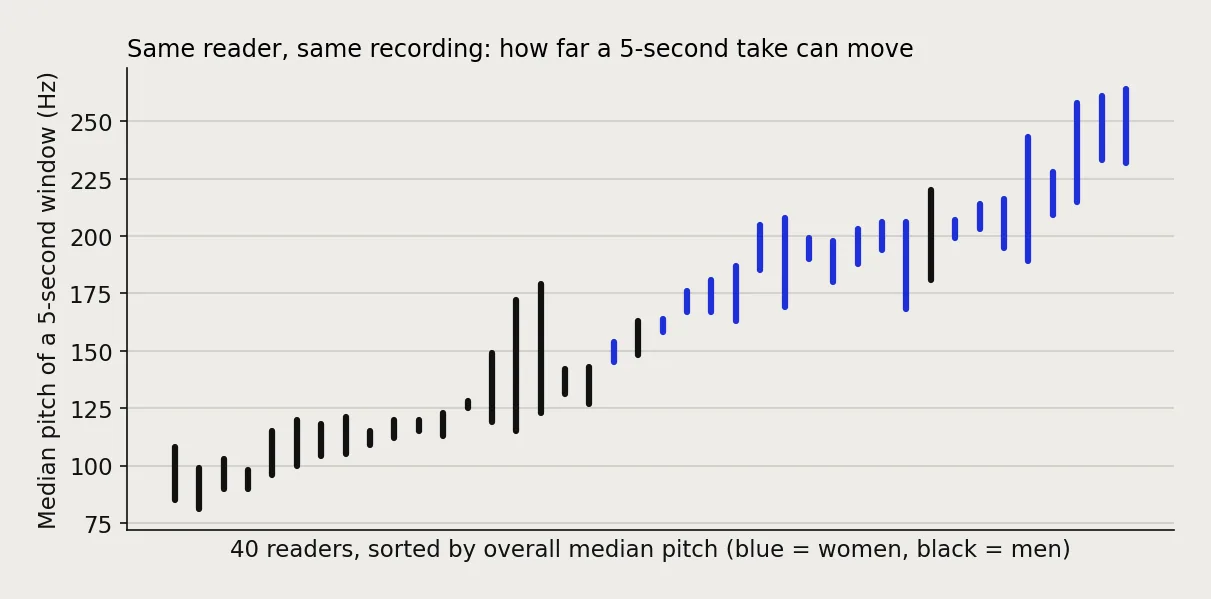
We took 12 seconds of read speech from each of 40 LibriSpeech readers, 20 women and 20 men, and cut each recording into eight overlapping 5-second windows. Five seconds is the length of a take on our main voice tests; the Hz test records eight. The speaker, microphone and room never change between windows; only the words do. We then measured the median pitch of every window with the code our Hz test uses.
| Measure | Typical | 1 in 10 or more (largest seen for ranges) |
|---|---|---|
| Range of median pitch across eight 5-second windows of one reading | 16 Hz (about 10% of the speaker's pitch) | largest 57 Hz |
| Gap between two single 5-second takes | 5 Hz | 19 Hz or more |
| Gap between two middle-of-three readings | 2 Hz | 10 Hz or more |
| Range of the feminine percentage across the eight windows | 5 points | largest 47 points |
Across the eight windows of one reading, the lowest and highest median pitch were typically 16 Hz apart (18.5 Hz for the women, 15.5 Hz for the men). Comparing just two windows is milder: half of all pairs differed by 5 Hz or less, but one pair in ten differed by 19 Hz or more. So a single take can land 15 to 20 Hz away from the next with nothing changing except the sentence.
The feminine percentage usually held within a few points: the median range was 5, and 33 of 40 speakers stayed within 13. The 8 voices that scored in the middle of the scale (30 to 70%) moved more, by 7 to 20 points, and one male reader who scored 24% overall moved by 47. Treat a single gender-detector percentage as a rough read, not a score.
A routine that makes readings comparable
- Pick one passage and keep it. Write down two or three sentences and read exactly those every time. Changing the words is the only thing that varied in the data above, so it is the one source of movement we can measure here.
- Record three takes and keep the middle one. In our windows, taking the middle of three cut the typical gap between two readings from 5 Hz to 2 Hz, and the one-in-ten gap from 19 Hz to 10 Hz.
- Also record your everyday voice. Take some readings in the voice you use in conversation as well as your practice voice. The gap between the two shows how much has carried over.
- Keep the setup fixed. Same room, same device, the microphone about a hand's width from your mouth. Background noise changes the measurements in its own way, as shown in how background noise changes a voice test result.
- Record at a similar time of day. Pitch and roughness can differ between morning and evening, so pick a time you can repeat. We have not measured this on our tools.
- Log it, with a note. On the gender, Hz and deep voice tests, press Save this reading after a take. The site keeps the date, your median pitch and, on the gender test, the feminine percentage, in your browser only, and draws a line of your saved readings. No audio is stored. Because the log lives in this browser, clearing site data or switching device clears it, so copy the numbers into your own notes if you want a permanent record, along with what you practised and how your voice felt.
When a change counts
Compare sessions using the middle of three takes, not single takes. In our data, two middle-of-three readings differed by 10 Hz or more about one time in ten. That is a resampling estimate from overlapping windows, so treat it as a guide rather than a threshold: a change under about 10 Hz between two sessions is within normal wobble. A larger change that appears in all three takes and is still there a week later is much more likely to be real.
Look at the trend across many saved readings rather than any pair. A line that drifts in your intended direction across several weeks, even with day-to-day wobble, tells you more than one exciting session.
How long until a change shows?
There is no honest universal answer, and we have no data on training timelines, so we will not invent one. It varies a lot between people, goals and how often you practise. What the measurements above can tell you is how big a change has to be before you can trust it, and that a trend over several weeks is the signal worth watching. For a realistic pace for your own goals, a speech-language pathologist or experienced voice coach is the right source.
Track resonance, not only pitch
Pitch is the easiest number to move and the easiest to measure, which makes it tempting to track nothing else. But in our pitch vs resonance test, raising the pitch of 20 male voices to about 200 Hz without changing resonance fooled a pitch-based reading every time and a speech model only 3 times. If your pitch is rising but your voice still is not heard the way you want, resonance is the likely gap. The gender detector's optional deep resonance check gives you a second reading that pitch alone cannot move.
Look after your voice
Progress in voice training comes from practice spread over weeks, not from forcing a number up in one session. If your voice feels tired, hoarse or tight, stop for the day. Our tools report jitter and clarity, but we have not validated them as strain detectors, so trust how your voice feels over any number. For lasting hoarseness, pain or loss of voice, see a doctor or a speech-language pathologist, and if you can, train with a qualified voice coach who can hear what a test cannot.
Limits of this test
The windows in this test overlap and come from read speech, so the spread between truly separate takes, and in casual speech, is likely to be a little larger. Forty readers is a modest sample. The rule of thumb above is a starting point for your own voice, not a clinical threshold.
Start your log today. Record your passage, keep the middle of three takes, and press Save this reading.
Open the voice gender detector